Two hands approach each other on the ceiling of the Sistine Chapel. God extends his hand with gathered force. Adam raises his from the earth. Their fingers almost meet.
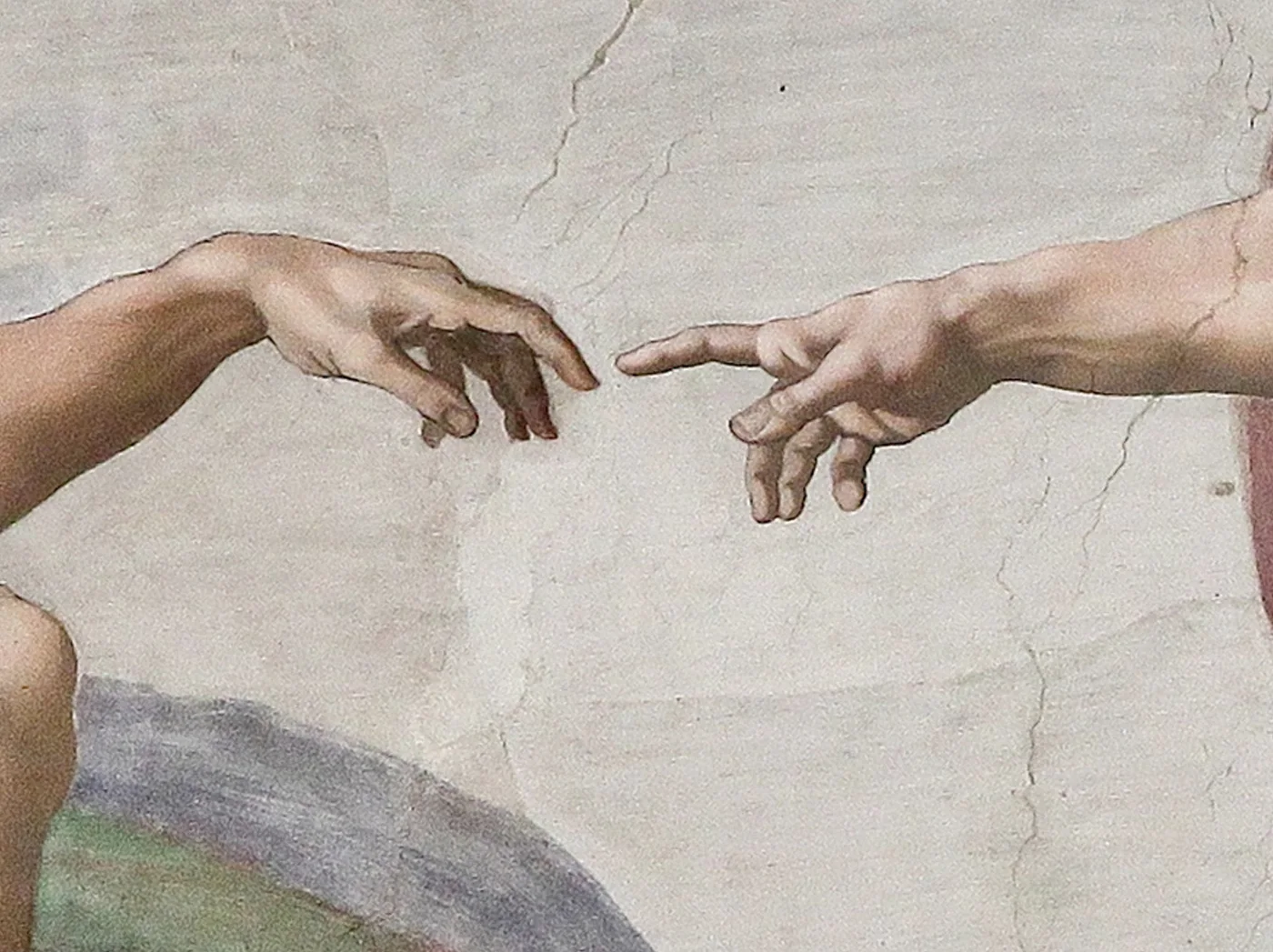
Michelangelo, The Creation of Adam, c. 1511–1512, detail. The current is invisible; the relation between source and receiver gives it form.
The narrow interval holds the passage from divine source to human receiver. An invisible current descends toward a body prepared to carry it. Potential becomes animation through this reception. Michelangelo’s image reveals both human creation and human purpose.
Spirit enters history through an instrument. An image becomes pigment, harmony becomes pressure in air, and form meets stone. Consciousness receives what has no body. The trained hand gives it a body with consequences in the world. Art performs this incarnation deliberately.
The Form Descends
Participation describes how a visible thing carries a reality that exceeds its material. The Greek term is methexis. A statue participates in beauty, and a melody participates in harmony. A sacred image carries a presence that exceeds pigment and wood.
Emanation describes the movement of that form into embodiment. Form descends from an intelligible source through image and body into matter. The source remains whole through the descent. One flame lights another without diminishing itself. A pattern enters many embodiments while exceeding each one.
Plato gives this transmission a concrete image in Ion. The Muse acts as a lodestone. Poet, performer, and audience form a chain of magnetized rings. Each receives the force and passes it onward. Plato calls this condition enthousiasmos, the god within.
Inspiration thus follows a transmission chain. A source awakens a receiver, who relays the force to another receiver. The audience completes a passage that began beyond the poet.
Plotinus describes the artist’s relation to this unseen source through Phidias and Zeus. Phidias reached toward the god’s intelligible form instead of copying a visible man. His sculpture renders how Zeus would appear if the god became visible. The artist gives an unseen order a body within the world.
intelligible or imaginal form
            ↓
     attention and intellect
            ↓
       the living body
            ↓
       hand · voice · tool
            ↓
      resistant material
            ↓
       the shared world
This chain describes the aesthetic operation of The Human Instrument. What the maker receives inwardly as inspiration becomes a new object in history.
The Human Being Is the Hinge
Aristotle’s hylomorphism describes the earthly joining of matter and form. Its Greek terms are hylē, matter, and morphē, form. A maker holds the form of a house and carries it into timber. Bronze becomes a figure when proportion passes through judgment, body, and tool.
Later Platonic and Christian accounts extend this relation toward a prior spiritual order. The maker receives the form before giving it material expression. A divine idea or archetype supplies that form in one account. Other accounts name an imaginal encounter, Muse, daimon, dream, or deeper ground of the soul. These sources differ, while the passage from received form to embodiment remains.
spirit → form → human instrument → matter → consequenceReception passes through a particular life. Memory and culture shape what the maker recognizes. Wounds and temperament also shape reception, while judgment and love direct the response. The material brings its own requirements. The maker chooses, refuses, revises, and answers for the result.
The human therefore participates in the form’s origin and transformation. A received form changes as it crosses this particular body. Through the artist, the field becomes this form in this world.
Leonardo’s Vitruvian Man gives the human instrument a visible geometry. The figure stands within circle and square, joining celestial proportion to terrestrial measure. Extended arms and legs give invisible relations a bodily scale. The body measures the passage between idea and world. Leonardo joins extraordinary receptivity to an eye and hand trained to transmit what they receive.
The Hand Completes the Crossing
The hand brings possibility into history. Through pressure and distance, it discovers the material’s response. Weight and rhythm shape each movement, while grain and resistance direct its course. An idea acquires the conditions of gravity. Spirit encounters the terms of embodiment through these acts.
Henri Focillon’s In Praise of Hands describes the hand as an organ of knowledge. Touch gives contact with what sight leaves abstract. The hand learns through that contact, and matter answers through the hand. A line deviates, stone fractures, or a chord sounds differently in a room. These replies make the received form more specific.
Michelangelo calls the artist’s held form the concetto. His image places a waiting figure within marble, where the sculptor must free it. Recognition still requires the chisel to follow a line the stone will bear. One wrong blow can destroy what the artist has seen. Discovery proceeds through making, and making requires disciplined recognition.
The hand teaches spirit what it can become in a world with consequences. Each material reply returns knowledge through the body that carried the form outward.
Craft Preserves the Signal
A genuine reception can fail during transmission. A composer hears a relation that the ear cannot yet hold. A painter sees a proportion that the hand cannot carry. A writer receives a living image but buries it beneath dead language. Inspiration opens reception; craft keeps the received pattern coherent as it enters matter.
Chord language distinguishes these functions. Bandwidth names the range an instrument receives, while coherence describes its ability to retain the pattern. Craft matches the inner form to the outer material’s resistance. These terms describe artistic reception and transmission through their shared relations.
Practice prepares the body for this passage. Scales and rehearsals train the musician to carry what the musician hears. Sketches and repeated studies of hands train the painter’s eye and movement. Failed drafts reveal where a writer loses the received image. Such labor makes inspiration transmissible.
Reception without craft leaves fragments and claims. Craft without encounter produces competent repetition. Great art joins wide reception to an instrument disciplined enough to carry what enters. Genius holds reception and transmission together in one coherent body. Its work requires both the encounter and the ability to embody it.
Found Through Making
A form precedes the work as possibility. Its embodiment enters history as something new. Finding and making meet in that passage.
Plato places the form above the artist. Jung places it within the collective depths. The mystic encounters above and within along the same axis. The image arrives with the force of something found. The maker must still produce its particular body through acts that change the field.
The first mark begins that change. Material answers, and the maker recognizes or refuses the result. Revision carries the encounter toward a form that can hold in the world. The completed work develops through this exchange, rather than waiting elsewhere for a passive hand to copy it.
received possibility
       ↓
    first act
       ↓
material answers
       ↓
recognition and revision
       ↓
embodied form
The marble holds many possible figures. The artist encounters one and gives the encounter an irreversible consequence through action. Discovery and authorship both remain within this relation. The work is found through making: received as possibility and forged into actuality.
The Image of the Maker
The theological tradition gives making a divine relation. A being made in the image of a Maker also makes. Human creation continues an act whose source exceeds the human maker.
Coleridge describes imagination as the finite repetition of an eternal creative act. Tolkien names the human expression sub-creation. A created being continues creation within inherited conditions. Dorothy Sayers describes a Trinitarian rhythm through the work’s idea, activity, and power of reception. Each account identifies how human making carries a prior creative power.
Kabbalah describes movement through both descent and return. Form descends through worlds into matter. Human work raises scattered sparks toward conscious relation. Art joins these directions by giving spirit a body that carries consciousness onward.
spirit descends as form
          ↓
the human gives form a body
          ↓
matter carries consciousness
          ↓
another human receives and answers
The finished artifact becomes another instrument. A poem reorganizes language in its reader. A building teaches bodies how to gather, while a melody entrains breath and memory. An image makes an invisible relation available to sight. Incarnation begins in one vessel and continues through others.
Beauty gives this coherence a felt signature. The beholder encounters matter carrying an order beyond what the material alone explains. Awe and frisson mark this recognition through the body. Silence, tears, and widened attention also register the encounter. Another instrument begins to resonate with the form.
Art Is a Form of the Work
Art trains the human instrument in reception and transmission. Stillness and contemplation open attention to received form. Dream and play also admit forms beyond deliberate planning. Study, repetition, and imitation develop the ability to carry them. Critique and revision refine that transmission.
Release gives the work consequences beyond the maker’s immediate control. What returns teaches the maker where fear or vanity distorted the form. Haste and incapacity become visible through the same exchange. The artist learns what the instrument must retain or change before another work.
This discipline brings The Great Work to human scale:
Receive widely. Hold faithfully. Make precisely. Release responsibly. Learn from what returns.
The finished work gives the received form a new body in the shared world. Something without hands has acted through human hands. Something without a voice can speak after the maker has gone. Its passage continues through the persons who receive and answer it.
Michelangelo’s fingers remain separated by a narrow interval. Art crosses that interval.
References
Aristotle. Metaphysics, VII.7.
Coleridge, Samuel Taylor. Biographia Literaria. 1817.
Focillon, Henri. “In Praise of Hands.” In The Life of Forms in Art.
Michelangelo Buonarroti. Rime, “Non ha l’ottimo artista alcun concetto.”
Michelangelo Buonarroti. The Creation of Adam. c. 1511–1512. Sistine Chapel ceiling. Detail image, public domain.

Plato. Ion.
Plotinus. Enneads, V.8.
Sayers, Dorothy L. The Mind of the Maker. Methuen, 1941.
Tolkien, J.R.R. “On Fairy-Stories.” 1939.
Vitruvius. De architectura, III.1.