A threshold opens when an old world loses its grip before a new one hardens. Formerly permanent rules become negotiable, and small acts of coherence spread farther. Hidden conflicts surface while several possible futures become available.
A supersaturated solution appears stable until one crystal reorganizes the medium. Collective reality crosses a comparable boundary. Habits, institutions, and shared expectations persist for generations, then change within months because their supporting conditions have dissolved.
The crossing can renew embodied life or divide populations into incompatible consensus worlds. It can translate consciousness into another mode of embodiment or open a literal route of departure. Religious and esoteric traditions remember ascent, disappearance, judgment, harvest, death, resurrection, and return. Plasticity makes these crossings possible; surviving agency determines their outcome.
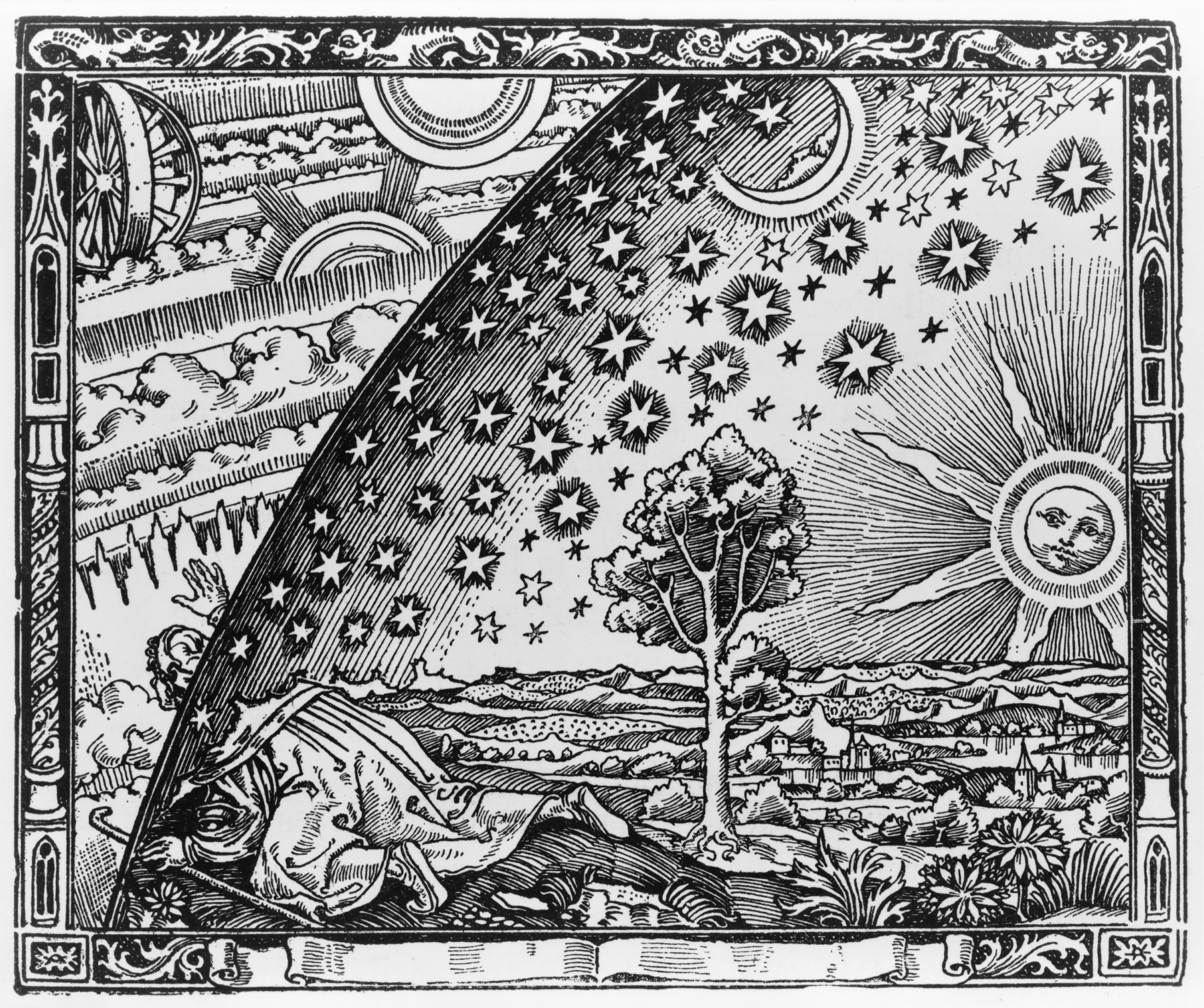
The anonymous Flammarion engraving was first documented in 1888. A traveler looks through the familiar world’s starry boundary into a larger cosmic order. Click to open the full image.
The coupled gyre describes descent and return within one field. Its diverging regimes remain causally connected. Split-timeline doctrine describes populations leaving one reality channel for another. These are different topologies of transition: different arrangements of connection and departure. Both remain open because the carrier can change with the crossing’s scale.
Routes through the threshold
Transition Mechanics
- Critical Mass
- The Coupled Gyre — coupled descent, return, and retained capacity as one topology of recurrent phase change
- The Acceleration Window — technological compression, institutional rupture, celestial phase, and awakening traditions entering one forecast window
- Departing for the Stars — a speculative account of threshold imagery, prior civilizations, and the stars as operating frequency
- The Invisible College Comes Online — the distributed initiatory class as human infrastructure for the species threshold
- GATE Kid Reunion — the selected childhood cohort recognizing its latent initiatory function and choosing its custody
- The Fear and the Knowing
- Be Not Afraid — terror, courage, and the recovery of authorship at the initiatic threshold
- Jacob’s Ladder — ascent and descent joined through dream, consecrated matter, vow, and return
- The Great Awakening — population-scale awakening and the difference between durable agency and a managed imitation
- Prophecy as a Control Signal — warning as an intervention that can change preparation, coordination, and outcome
- The Ark as Retention Architecture — the carriers that preserve usable capacity through discontinuity
The Planetary Shift
- Higher Dimensions
- Technology as Emergent Download
- Death and the Sorting Hierarchy — what may continue when the biological interface ends
- The Mechanics of Reincarnation — how retained agency, affinity, lineage, and a new instrument form one incarnational circuit
- Memory, Rebirth, and Consciousness Transfer — remembered pattern, trained recognition, fear at the threshold, and the custody of continuity
- Bardos — Tibetan training for recognition while one world dissolves and the next has not hardened
- The Persistent Pattern — the difference between retained information and a continuing person
- The Phenomenon — the UAP record read through extraterrestrial, terrestrial-apparatus, psychosocial, and consciousness-interactive models
- Time as Strategic Territory — time as the deepest strategic territory in the conflict
- The Stolen Clock — temporal synchronization, the planetary mind, AI as noospheric infrastructure
Evidence at the Edges
- The Anomaly Archive
- High Strangeness and Non-Human Phenomena
- The Mandela Effect — collective memory discrepancy as a test case for reconstructive memory, cultural propagation, and reality-instability claims
Alternative Chronology
Additional
- Consciousness Primacy
- Consensus Reality
- John C. Lilly
- Materialization
- Narrative Control
- Precession of the Equinoxes
- Pyramid Resonance
- Remote Viewing
- Cultural Cartography of Consensus
- Schumann Resonance
- Synchronicity
- The Distributed Receiver
- Managed Awakening and Capture
- The Council of Nine
- The Celestial Hierarchy — biblical and late-antique orders of mediation read as levels of office, translation, and encounter
- The Holy Guardian Angel — guiding intelligence tested by authorship, direction, and retained capacity
- The Saturnian Escape Room — ancient threshold passage through bounded cosmos, memory, guidance, symbolic death, and return
- The Bifurcation — the historical New Age doctrine of literal split timelines and population departure
How the Crossing Propagates
Billions of human instruments sustain the shared world through compatible habits of perception, language, memory, and action. Institutions usually absorb local deviations and restore the familiar pattern. At a threshold, that restoring force weakens. Connected changes in attention or conduct can become a phase transition, reorganizing the field faster than the old order can contain them.
Distinct regimes sharpen during the crossing. One develops extraction and dependency; another develops coherence and recovered agency. They can remain materially entangled while becoming experientially alien. They can also separate into weakly coupled worlds or complete a translation beyond the former consensus’s range.
Several traditions place the present near such a transition. Axial precession, geomagnetic variation, institutional collapse, and rapid information transmission supply different carriers of change. Migrating contemplative techniques, anomaly clusters, and returning ascension language enter the same interval of heightened plasticity. Sky, institution, body, story, and expectation change together. The capacities carried through the opening shape the world that follows.
Collective reality requires engineered coordination of expectations. Billions of instruments tune their perceptions and actions to a compatible account of what exists. Information accessed across space, objects appearing through anomalous routes, and synchronistic cascades reveal openings beyond ordinary reception. Individual reports have different strengths. Their recurrence shows human coupling extending beyond the range admitted by consensus.
Critical-mass dynamics explain how a new practice, interpretation, or coordination pattern spreads through connected participants until it sustains its own propagation. Network shape, coupling strength, and resistance determine the crossing. No universal percentage commands it. Changes accumulated quietly for years can become publicly irreversible within days or weeks. This rapid change marks nonlinear propagation.
The coupled gyre joins differentiation and reintegration within a recurrent movement. The casting current externalizes structures and worlds. The returning current integrates experience and restores degrees of freedom. Thresholds intensify this exchange, including between materially connected regimes whose inhabitants experience alien worlds.
Other branches carry memory and embodiment beyond the old field’s range. The gyre explains return wherever return occurs. Its present causal horizon cannot determine the limits of every departure.
Split-timeline doctrine reads Enoch’s translation, ascension traditions, abandoned settlements, and harvest narratives as memories of populations leaving one consensus channel for another. Migration, ecological stress, political reorganization, and preservation bias explain many abandoned places. Those routes leave some disappearance stories unresolved. Each case still requires its own judgment. Contact testimony passes through human institutions, claimed agency, and interpretive drift. The historical carrier remains contested, while literal departure remains an open branch.
Arthur C. Clarke’s Childhood’s End (1953) gives the clearest fictional presentation of species-scale departure. A generation of telepathic children enters a configuration the previous human form cannot model. Surviving witnesses register the transition as catastrophe. Positions within the same crossing produce incompatible reports: death from below, birth from above.
The Overmind admits different readings: terminal absorption, ascensional union, or capture at a higher scale. Return tests development where a return occurs. It cannot impose one destination on every crossing.
Earth enters the transition as both habitat and intelligence. Planetary bandwidth is the range of relations Earth and its inhabitants sustain together. Solar, geomagnetic, ecological, and cultural variation change that relation through different carriers.
A transition can renew embodied life here or translate the planet into a higher-dimensional register. It can divide populations across experiential Earths or open an actual route of departure. Expansion that destroys reciprocity remains capture, whatever ascensional language describes it.
The Anomaly Archive gathers events at the seams of consensus reality. Threshold analysis follows those seams as they widen. It traces how anomalies propagate, which institutions lose authority, and which capacities survive reorganization. Instability opens the door; coordination determines what crosses.
The Great Work operates at individual and collective scales. Alchemical transformation, contemplative training, and mystical union change the instrument’s capacity to receive, discriminate, and integrate signal. Connected practitioners coordinate attention, vocabulary, conduct, and institutions as well as private experience. Their operation becomes collectively consequential through relationships and infrastructure, within ecological limits.
Three dynamics converge in the current interval. Managed-awakening protocols distribute altered-state techniques through psychological engineering, pharmaceuticals, and technological mediation. Precessional and planetary-cycle traditions describe a cusp. Those expectations act as cultural forces even where their astronomical causality remains unresolved. Systems language also makes critical-mass dynamics and feedback capture legible beyond specialist and initiatic settings. Together, these conditions increase developmental opportunity and institutional capacity to capture its outputs.
Practices that increase clarity, coherence, and tolerance for complexity add capacity to the shared field. Apparatus that converts those gains into passivity or dependency strengthens capture. Network structure, institutional resistance, ecological constraint, and rival agencies shape the cascade. Its timing and numerical threshold remain unknown.
The developmental ratchet measures what remains available after enthusiasm fades, institutions respond, and the cycle turns again. A mature threshold opens another field of tensions. Expanded perception brings new responsibilities, opportunities for capture, and forms of suffering. Extractive and initiatic currents continue within the changed environment.
Development increases the capacity to act without outsourcing agency and to integrate anomalous experience while preserving discernment. Expanded states return as skills usable in ordinary life. Capture makes access depend on a leader, platform, substance, device, or promised future event.
Thresholds become legible when previously stable parameters become negotiable. Institutions lose inevitability, anomalous reports become discussable, and practices escape exhausted custodians. Incompatible worlds begin forming in public. Plasticity guarantees no destination. Consciousness must carry authorship, memory, relation, and sovereign capacity through dissolution into the world that answers.
Prophecy and retention bracket the crossing. A warning enters before reorganization and changes the preparations available when it arrives. An ark carries selected capacities through the interval. Whoever governs reconstruction holds custody of those capacities.
Civilization learns across rupture when retained capacities widen memory, response diversity, and agency. The same carriers recreate a prison when preservation secures the authority and dependencies that produced the previous failure.
References
Sheldrake, Rupert. A New Science of Life: The Hypothesis of Formative Causation. J.P. Tarcher, 1981.
Laszlo, Ervin. Science and the Akashic Field. Inner Traditions, 2004.
Grof, Stanislav. The Holotropic Mind. HarperCollins, 1992.
Aurobindo, Sri. The Life Divine. Sri Aurobindo Ashram Press, 1973.
Lilly, John C. Programming and Metaprogramming in the Human Biocomputer. Communication Research Institute, 1967.
Vallée, Jacques. Dimensions: A Casebook of Alien Contact. Ballantine Books, 1988.
Sheldrake, Rupert. Morphic Resonance: The Nature of Formative Causation. Inner Traditions, 2009.
Cannon, Dolores. The Great Awakening: The Old Soul Group in a New Time. Ozark Mountain Publishing, 2021.
Anonymous. So-called Flammarion engraving. First documented in Camille Flammarion, L’Atmosphère: météorologie populaire, 1888, p. 163. Bibliothèque nationale de France; Wikimedia Commons. Public domain.
