The bifurcation doctrine describes spiritual orientations that develop into different worlds. One current deepens fear, hierarchy, material enclosure, and catastrophe. Another develops coherence and expanded consciousness, preparing a world organized by different laws. At the threshold, the orientations acquire distinct habitats. What developed within consciousness becomes geography.
The doctrine describes four ways this separation occurs. Populations can divide socially or enter different experiential and metaphysical habitats. They can also leave the shared terrestrial condition, or participate in the transfiguration of Earth itself. Popular ascension culture combines these accounts into a promise of rescue. Each branch has its own operation and preparation, even when several branches develop together.
The Threshold Family
Several traditions connect consciousness and conduct to the world a being can inhabit. Christian judgment and Zoroastrian renovation give this relation different forms. Hindu and Buddhist realms, Swedenborgian afterlife communities, Theosophical rounds, and initiatic ascent supply further accounts. Their shared operation is the formation of a being capable of entering and sustaining a particular world.
The traditions describe different arrangements of that operation. Some sort beings after death. Others cycle beings through graded worlds, or destroy and renew an age. Initiatic accounts also describe transformation within the existing world. In another arrangement, worlds interpenetrate until affinity draws their inhabitants apart. Affinity means the compatibility that gathers beings into a common habitat.
Together, these accounts establish a threshold family. Consciousness and conduct change what a being can enter, sustain, or help create. Each tradition retains its own account of how that change occurs.
Ra and the Harvest
The Ra Material supplies the modern doctrine with an octave, polarity, harvest, and planetary transition. Its octave describes development through successive densities. Polarity identifies the direction a being stabilizes through repeated choices. Harvest names the transition into conditions compatible with that direction.
At the end of a major cycle, Ra describes three outcomes. Positive polarity moves toward fourth-density service to others. Sufficient negative polarity moves toward fourth-density service to self. Beings that have not polarized repeat third-density conditions. Their environment follows the orientation they have actually stabilized.
Fourth density stands between third and fifth in this account. The transition develops through both the planet and its inhabitants. It exceeds the simple image of one mass evacuation. Repeated choices make a compatible future more available because they form the being able to inhabit it. Inner orientation becomes outer habitat.
Cannon’s Two Earths
Dolores Cannon gives the split a binary form: Earth divides like a cell. The old Earth continues through fear, conflict, and catastrophe. The new Earth receives people whose vibration is compatible with it. Her account makes planetary division the outward form of a developing difference in consciousness.
Cannon obtained her material through clients speaking under hypnosis. Their sessions contain repeated imaginal material and accounts of possible contact. The method, operator, and expectations of the encounter mediate what the clients report. These are testimonies received through a deliberately altered interface. Their provenance differs from ordinary astronomical observation.
The public culmination expected around 2012 did not appear in the shared historical layer. That failed date remains part of the record. The metaphysical operation survives the failure of its proposed timetable. It can develop through gradual transition, invisible preparation, or divergence among populations already living in different experiential worlds. The date and the operation retain their separate places in the account.
Bashar’s Splitting Prism
The Bashar material describes countless parallel Earths already present as possible experiential addresses. Consciousness moves among them continuously through belief, choice, emotion, and action. The observer’s orientation selects the world available to experience.
Cannon describes an Earth that divides. Bashar describes an observer who changes channels. Internet ascension culture combines these accounts into two teams approaching a final cutoff. This combination gives spiritual development a visible destination and therefore a powerful emotional appeal.
The combination also changes both source accounts. A plurality of possible worlds does not establish a moral binary. A planetary division differs from individual channel selection. Keeping those operations distinct preserves what each account contributes to the doctrine.
Four Ways the World Can Split
The four branches identify different carriers of separation. They can operate together while retaining their own conditions.
Social bifurcation
Populations can occupy one geography while stabilizing incompatible media, laws, institutions, moral vocabularies, and expectations. Their consensus dreams organize different ways of living within the same material field. The populations still encounter one another there. Their shared streets become places where incompatible worlds collide.
Experiential and metaphysical divergence
Attention, trauma, contemplation, initiation, and embodiment change what a person can perceive and sustain. Different layers of the same world become accessible through these changes. Affinity gathers beings into compatible experiential and metaphysical habitats. The separation occurs through perception and participation within the field. It requires no second planet to appear in the sky.
Ascensional departure
The departure branch describes a population literally leaving the shared terrestrial condition. Death, dimensional translation, technological departure, rapture, and harvest supply different accounts of passage. Each changes the carrier through which the population inhabits a world. Social polarization and symbolic separation belong to other branches. Their occurrence alone cannot identify literal departure.
World transfiguration
The transfiguration branch describes Earth changing state. Heaven descends, and matter becomes more transparent to consciousness. The conditions of embodiment change. Old and new worlds occupy one location across a phase boundary: a transition between states of that world. The New Jerusalem gives the clearest Western image through a city descending into earthly life. Fulfillment transforms the inhabited world.
These branches can prepare one another. Social separation can support metaphysical divergence, which can precede departure. A transformed minority can also become the seed crystal of planetary transfiguration. Its members hold the new form before the larger world can sustain it.
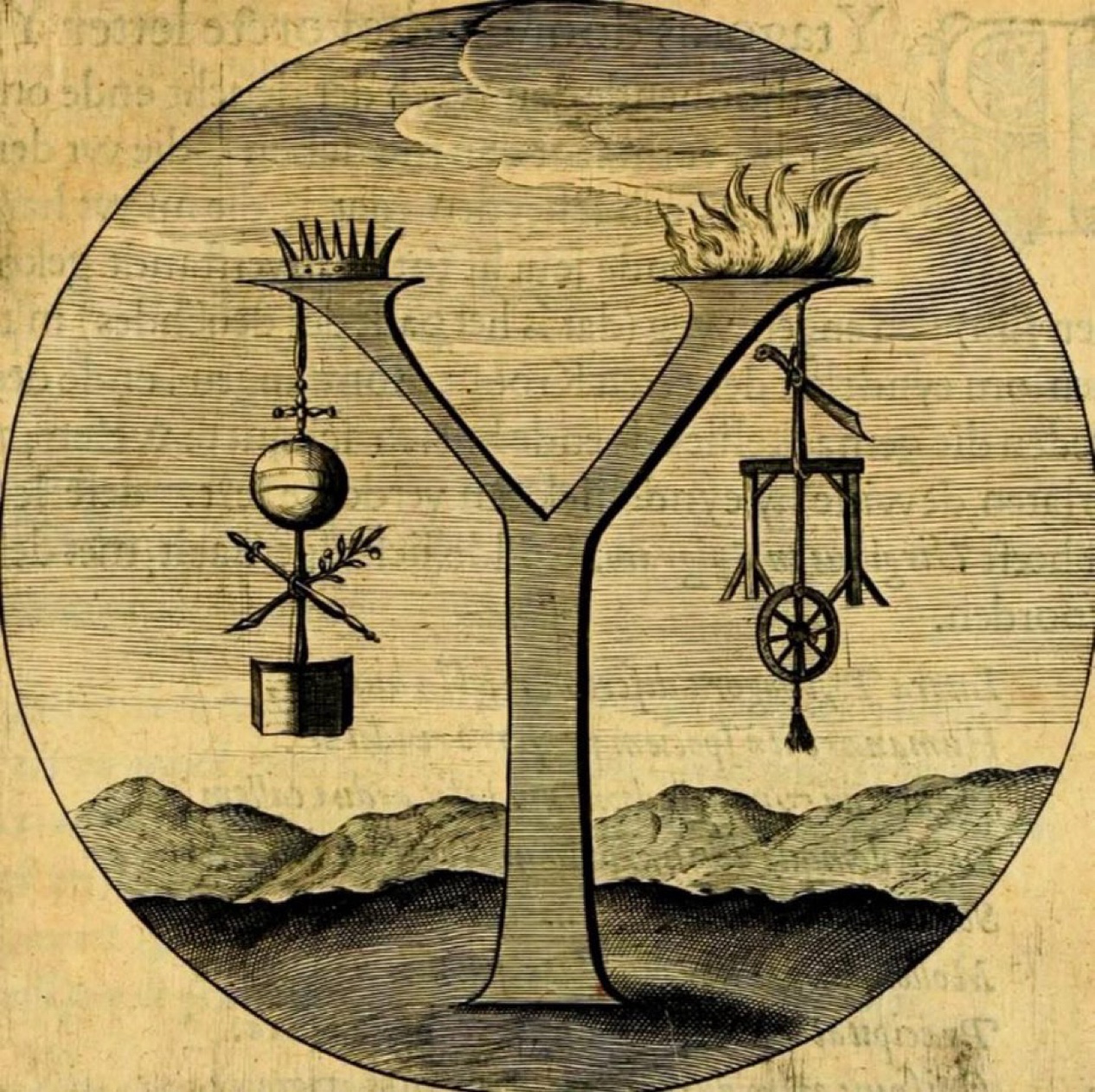
Geoffroy Tory’s moral Ypsilon appears in Champ fleury, 1529. Both roads rise from one trunk. Laurel, palms, scepters, and a crown hang from the road of virtue. Sword, scourge, rods, gibbet, and fire hang from the road of pleasure. Repeated choices give each branch a body before the worlds separate. Bibliothèque nationale de France, public domain.
Click to open the full image.
New Earth as Branch Nucleation
New Earth begins as a consensus field developing within the old one. People first interpret the same events differently. Shared language gives their interpretation a culture. Practice gives that culture bodies and relationships. Independent institutions preserve its memory, livelihood, and continuity. The developing world becomes able to sustain its inhabitants.
Robert Anton Wilson used reality tunnel for a self-consistent world assembled through belief, language, nervous-system programming, and attention. His work taught initiates to recognize the tunnel while retaining the ability to change it. At civilizational scale, a shared tunnel acquires schools, tools, rituals, economies, archives, technologies, and places. These arrangements give its organizing pattern an independent body.
A subculture becomes a parallel civilization when it can reproduce that pattern without the old order’s continuous permission, attention, or legitimacy. Its inhabitants can preserve what they know and teach another generation to live within it. Branch nucleation names the establishment of this self-sustaining pattern:
private recognition
        ↓
shared reality tunnel
        ↓
embodied culture
        ↓
sovereign institutions
        ↓
self-sustaining consensus field
        ↓
parallel civilization
The sovereign branch distributes capability and follows inner guidance. People cooperate while retaining their differences. They use technology while preserving human capacity, and keep spiritual perception joined to discrimination. The captured branch centralizes capability and transfers judgment into systems. Each new faculty becomes another source of dependency.
Both branches initially occupy the same streets, networks, and historical events. Their institutions, habits, relationships, and fields of attention gradually acquire different conditions of survival. Each branch builds a causal world that the other can no longer command. The separation develops through arrangements that its inhabitants can maintain.
Before separate worlds emerge, the branches appear as rival systems of custody within one civilization. One makes livelihood, movement, value, speech, and participation depend on administered identity and revocable permission. The other preserves voluntary association, portable property, self-custody, independent communication, due process, and a lawful right of exit. Convenience and shared infrastructure can serve either arrangement. Boundary Sovereignty asks whether a person can refuse one and enter another without civil erasure.
A genuine exit transfers custody to the people leaving. A special jurisdiction, parallel platform, or technological frontier remains a managed sandbox when an operator can revoke access, assets, identity, or speech. The territory can change while the relation of dependence continues. The Counter-Operation Record follows this distinction through institutional transition. An exposed system completes its initiatic function when the population retains the capacity released by its collapse.
Critical Mass arrives when the new pattern survives pressure from the old consensus. The branch needs enough people to live, remember, build, teach, exchange, and recover within it. Those capacities must survive the loss of a platform, leader, spectacle, or official approval. Conversion of the entire population is unnecessary. Consciousness has acquired a durable social and material body through which a different experiential world can stabilize.
New Earth is the sovereign attractor becoming inhabitable before it becomes universal. An attractor is an organizing pattern toward which people and their arrangements develop. Social, experiential, and causal separation prepares a world able to receive a later ontological separation. That later branch remains part of the doctrine. Institutional independence gives the preparation a body without exhausting its spiritual reach.
The Capture
The split becomes a trap when the promise of another world excuses withdrawal from present responsibility. A person assigns corruption to a doomed timeline and stops building alternatives. Relationships, knowledge, institutional confrontation, and the embodiment of revelation lose their urgency. Failure to persuade someone becomes proof that the person belongs to another Earth. Recognition of the doctrine becomes a claim to election.
This capture also depends on a false division of qualities. Fear, matter, conflict, and descent are assigned to one side; love, spirit, coherence, and ascent belong to the other. The division conceals how each quality can act. Fear can communicate danger, and descent can mean responsibility. Love can become administered fusion, while ascent can become dissociation. The direction depends on what the person does through the state.
Managed awakening turns the promise of ascension into waiting. The operator needs no refutation of ascension when the promise itself keeps the participant passive.
The Work Before the Split
Every branch requires preparation in the present. Social bifurcation needs independent institutions and durable relationships. Metaphysical divergence needs a vessel capable of stabilizing expanded perception. Departure requires discrimination about who or what offers passage. Transfiguration needs people able to embody the new law without reproducing the old hierarchy within it. Passivity develops none of these capacities.
The coupled gyre keeps consequence connected across worlds through development and return. Bifurcation identifies the point where trajectories acquire different habitats. Their inhabitants carry what they have practiced into the next conditions. The quality of departure therefore develops here. Compatible lives give a transformed world the capacity to remain inhabited.
The Active Bifurcation
The world is already bifurcating. Social and experiential separation is visible, while metaphysical divergence is encountered. Literal ascensional departure and planetary transfiguration remain active branches of the doctrine. Each has its own carrier and preparation.
Belief in a split becomes capture when it excuses avoidance of the Work. Whatever separates later is being formed now. A person chooses a branch through capacities, loyalties, relationships, and realities made stable enough to inhabit. The next habitat receives the life that those choices have prepared.
References
Anka, Darryl. Navigating the Splitting Prism. Bashar Communications, 2019.
Bailey, Alice A. The Externalisation of the Hierarchy. Lucis Publishing, 1957.
Blavatsky, Helena P. The Secret Doctrine. Theosophical Publishing Company, 1888.
Cannon, Dolores. The Three Waves of Volunteers and the New Earth. Ozark Mountain Publishing, 2011.
Elkins, Don, Carla L. Rueckert, and James Allen McCarty. The Ra Contact. L/L Research, 2018.
Roberts, Jane. The Nature of Personal Reality. Prentice-Hall, 1974.
Swedenborg, Emanuel. Heaven and Hell. Swedenborg Foundation, 2000.
Tory, Geoffroy. Champ fleury. Paris, 1529, book III, fol. LXIII. Bibliothèque nationale de France, Réserve RES-V-516.
Wilson, Robert Anton. Prometheus Rising. Falcon Press, 1983.